
A Signature Scent for Pharmacy Shelves: From Approved Sample to Bulk
A signature scent is not the sample you approved. It is the scent that still smells like that sample in the third production run, in a bottle that has spent a month in transit, in a store that is warmer than the bench. Most of the difference between a brand with a signature and a brand with a nice first batch is the handover between the approved sample and bulk production. The handover is a written process, not a promise.
Key takeaways
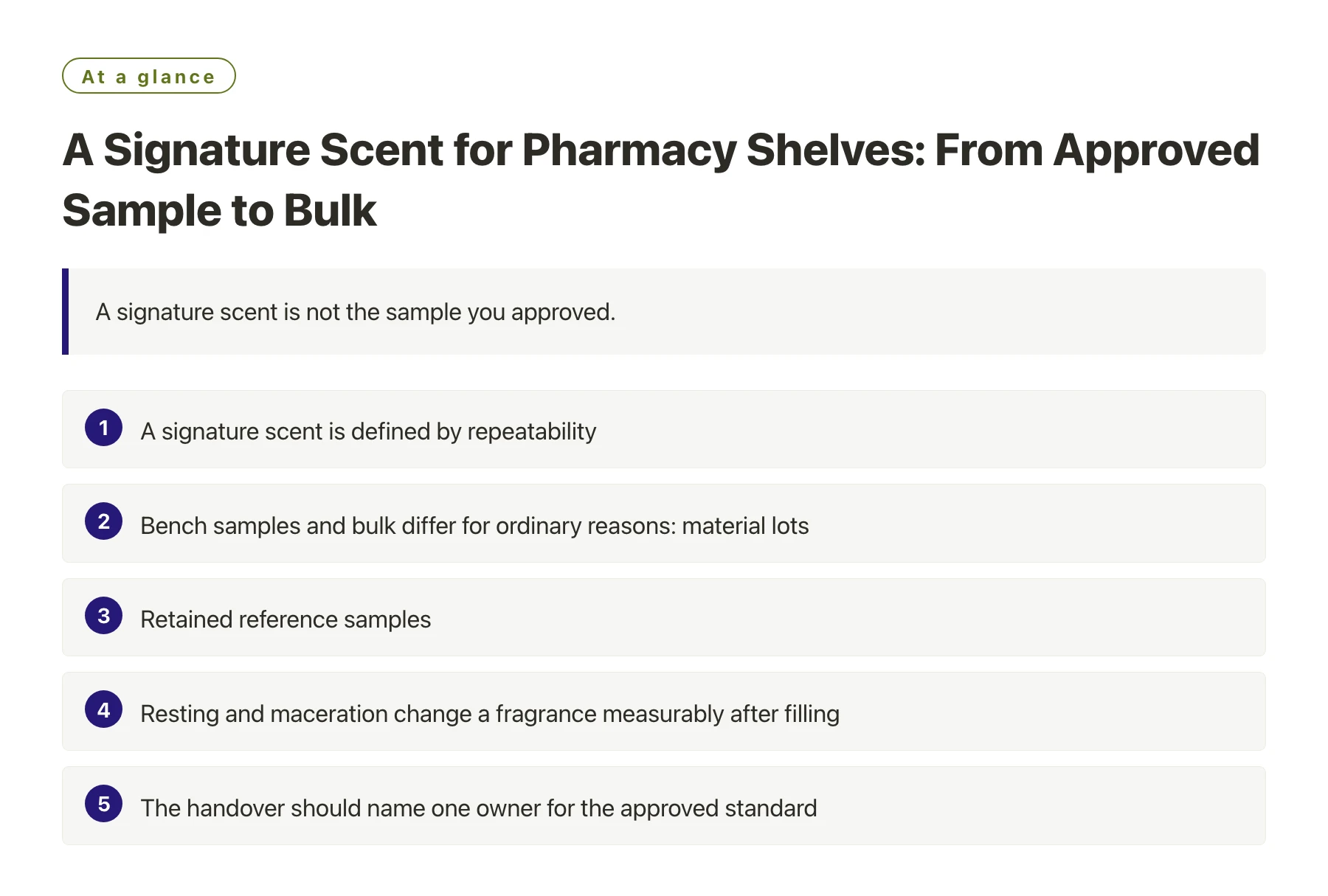
- A signature scent is defined by repeatability, so the approved sample has to be documented well enough that another batch can be measured against it.
- Bench samples and bulk differ for ordinary reasons: material lots, weighing accuracy, mixing scale, resting time and the container the liquid sits in.
- Retained reference samples, stored under controlled conditions on both sides, are the cheapest consistency control available to a small brand.
- Resting and maceration change a fragrance measurably after filling, so the scent approved on day one is not the scent that ships on day thirty.
- The handover should name one owner for the approved standard, so that a later change is a decision rather than a drift.
Founders tend to treat sample approval as the finish line, and factories tend to treat it as the start. The gap between those two views is where a signature scent is either created or lost. A bench sample is made in small quantities, often by hand, tested immediately and stored in one place. A production batch is weighed on different equipment, mixed at a larger scale and shipped, and its smell evolves as it rests.
This is written for a brand building a pharmacy own-label range, where the scent has to be legible to a shopper who is not looking for a niche experience and has to be identical across formats and repeat orders. The table below sets out where the gaps appear; the sections around it explain how to close them without making the process heavier than a first range needs.
What 'signature' asks of a pharmacy range
In a boutique context a signature scent can be complex and slowly revealing. In a pharmacy range it has a harder job: it must be recognisable within a few seconds, work across hand, body and home formats without losing its character, and still be recognisable a year later when the retailer extends the line. That combination argues for a relatively simple structure with a strong central idea, and for documentation that lets the idea be reproduced rather than remembered.
Developing that kind of scent through Xuelei custom perfume manufacturing means the factory holds the formula and the process while the brand holds the reference standard. Both jobs matter, and the handover between them is the part worth designing deliberately. A written specification, a reference sample and a named owner turn a good first batch into a repeatable product.
It is also worth deciding early how much the scent may move. Some drift is normal and unavoidable; the question is whether it is measured against a stated tolerance or noticed by a customer. Buyers who define the acceptable range before approval find the later conversations much shorter.
Where the gap opens between an approved sample and a bulk run
| Variable | In the bench sample | At bulk | How the gap is controlled |
|---|---|---|---|
| Material lots | Small quantities, often from one freshly opened lot | Larger purchases, sometimes from a different production lot of the same material | A specification that fixes the material and a change-notification commitment from the supplier |
| Weighing and dosage | Hand weighed, with tolerance that is generous relative to the total volume | Measured at production scale, where small ratio errors matter more | Calibrated equipment, recorded weighed quantities and a checked dilution step |
| Mixing | Mixed in small vessels with quick, even dispersion | Mixed in larger vessels, where order of addition and time change the result | A written compounding procedure naming addition order, temperature and mixing time |
| Resting | Rarely rested before the buyer smells it | Rested as part of the process, so it is smelled later in its life | An agreed resting period and a release check against the retained reference |
| Container and storage | Kept in a small bottle, often cool and dark | Filled into the saleable pack and stored or shipped in variable conditions | Compatibility testing on the actual pack and a shelf-life statement with storage guidance |
| Evaluation conditions | Smelled at a bench, at a moment chosen by the perfumer | Smelled by staff and shoppers, in stores and at home | A standard evaluation sheet and a consistent comparator, so both sides describe the same thing |
None of these gaps is a sign of a bad factory. They are the normal consequences of moving from a bench to a line, and each one is closed by a document rather than by goodwill.
Why the scent keeps changing after you approve it
A fragrance is a mixture that continues to react and rebalance after it is blended. Reactions between components proceed slowly, more volatile materials leave the mixture at different rates, and the balance the perfumer designed at the bench shifts during the first weeks in the bottle. That is why perfumery has always treated resting as part of production rather than as storage, and it is ordinary physical chemistry rather than a defect [1].
The practical consequence is that a sample approved on Monday and a bottle filled on Monday will not be identical on the following Monday. If the launch date allows, taste the bulk after resting and compare it with the reference before the pallet ships. If there is no time to rest and recheck, at least record the resting period and the release comparison so that later drift can be distinguished from a change in process.
Material quality and provenance are the other half of the story. Fragrance materials are subject to use restrictions based on safety assessment, and the same material from a different source can differ in odour profile even when it meets the same specification [2]. A supplier change is therefore a scent event as well as a procurement event, which is why change notification belongs in the supply agreement.
For a brand without a perfumer in house, the answer is not to become one. It is to describe the target in words that survive the handover, and to rely on comparison against a retained reference. Understanding why a sample and a bulk order differ is a documented topic in its own right, and reading up on it before the first production run costs a fraction of what a rejected batch costs why a sample and the bulk order can differ.
Build a little olfactory capability on your own side
A brand that can describe what it is smelling has a much better handover than one that can only say whether it likes it. Formal professional scent training is available in several formats, from short courses to longer programmes, and the value for a pharmacy own-label team is not expertise but vocabulary: a shared way of naming dosage, brightness, sweetness and drydown so that feedback means the same thing to the perfumer as it does to the buyer.
Start with the discipline of evaluation rather than with the chemistry. Blind, side-by-side comparison on the same carrier, at the same time of day, with a written note of each impression is enough to turn opinions into usable input.
The same vocabulary pays off at scale. If the range grows, the brand will eventually brief a second direction or a line extension, and the ability to describe the existing signature is what keeps the family coherent.
Write the approval as a document, not as an email. The approval record should name the sample code, the date, the dosage, the pack, the evaluators and the storage conditions of the retained reference. If a dispute about the scent ever arises, that single page decides it, and reconstructing it after the fact is close to impossible.
Sources
- Chemistry World (Royal Society of Chemistry) —— The Royal Society of Chemistry's magazine, covering chemistry research and explanations of everyday materials including aroma compounds.
- IFRA: Safe Use and Fragrance Science —— IFRA's explanation of how fragrance materials are scientifically assessed for safe use and how those conclusions are applied by the industry.
Frequently asked questions
How long should a fragrance rest before the bulk is shipped?
There is no single rule, because the needed period depends on the formula and the materials used. The important part is that a resting period is stated in the specification and that release happens against the retained reference rather than against a calendar alone.
Can a bulk order smell slightly different and still be acceptable?
Yes. Some movement is normal and unavoidable. What matters is that the acceptable range was defined before approval, and that the comparison is made methodically rather than by memory.
Should we change material suppliers to reduce cost?
Only with a documented odour comparison first. The same material from a different source can shift the profile of the finished scent, and a supplier change should be treated as a change to the product.
Who should keep the reference sample?
Both parties. The factory keeps one for release checks and the brand keeps one under controlled conditions for its own comparisons. Two references stored apart are far more useful than one held by either side.
What if the pharmacy range needs the same scent in several formats?
Expect each format to need its own compatibility check, because the base and the pack both affect how the fragrance reads. Approve the scent once, then verify it format by format rather than assuming it transfers.